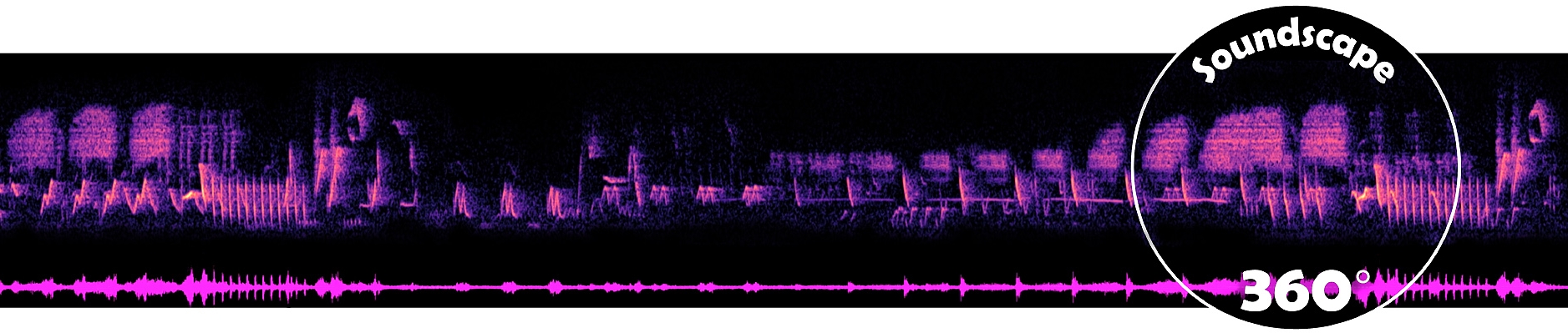
Soundscape360° documents our natural acoustic environment. It drops you for about one hour at various places on our planet and gives you insights into our acoustic environment. Each soundscape is captured by an audio field recorder. The so documented soundscapes are visualised with a 360-degree camera and spectrograms. The 360-degree camera films the acoustic surrounding or the habitat close to the sound recorder. The second visual tool are spectrograms. They are a fascinating way to visualise the frequencies of sound that varies with time. See them as the subtitle of a soundscape. The natural sounds of the spectrograms are annotated and give you deeper insights into the soundscape with all its vocal birds, mammals, amphibians, insects and noisy human disturbance.

bird sounds
What is a Soundscape?
A soundscape describes our acoustic environment and can be simply specified as the acoustic equivalent of a landscape. While landscapes address our eyes, soundscapes are perceptible only with our ears. So, step outside and close your eyes. What you hear is a soundscape.
Sounds can originate in two ways
- natural origin, i.e. biological (animal vocalisations: birds, frogs, insects, mammals) or non-biological (wind, water, waves, thunder)
- anthropogenic origin (human speech, music, sounds from cars, trains, airplanes, factories etc.).

mammal sounds
Each place on our planet has its unique soundscape. Spatial differences betweens soundscapes mainly come from differences in the manifold composition of vocal animal species. But soundscapes also vary temporally either depending on the daily or seasonally activity pattern of vocal animals or historically when vocal animals became extinct or immigrated to a new region. For example, the morning chorus of birds is most intense at sunrise, but slows down until noon. Birds mainly sing in the spring season. Historically extinct animal species will no more contribute to present soundscapes.

amphibian sounds
The downside is that we live in the Anthropocene and thus anthropogenic noise from airplanes, traffic and industry are part of many soundscapes. Thus, despite the documentary character of Soundscape360°, it aims to give acoustic pleasure to the listener and thus a sensitive reduction of anthropogenic noise is reduced whereever possbile. This can be done by a wise selection of the recording location and recording time. Most anthropogenic noise, such as distant roads or overflying airplanes, produce mainly low-frequency noise, which can be reduced with the aid of software. No cutting-out or other manipulative editing of the original sound file was done to preserve the documentary character of the soundscapes.

insect sounds
Technical Background
Each recorded soundscape consists of a sound recording made from a simple field recorder (Sony PCM D100 or Sony PCM D10). The 360 degree video is filmed by a special camera (Insta360 ONE X2) that is able to record the whole surrounding area. The audio from the video file is replaced by the high-quality audio of the field recorder. Spectrograms are compiled with R Statistical Software. Video and audio are syncronised to guarantee the documentary character of the soundscapes.

human sounds
How to use
You can use Soundscape360° in various ways. First of all just enjoy the positive vibes of our acoustic environment. This will definitely increase the quality of your life. Listen through the episodes for simply learning the different sounds of birds, mammals, frogs or other wildlife. Make Soundscape360° your ambient sound for relaxation, yoga, ASMR, while working or studying .
Please consider to subscribe to my Youtube channel or Instagram to support my work:
 Soundscape360°